A path through ECG-AI
From ECG signal to validated medical device.
Ruben Abbou
Education, research & teaching
University of Chicago.
M.S., Computational and Applied Mathematics, Machine Learning specialization · 2020–2022
B.S., Computational and Applied Mathematics · 2016–2020
B.A., Statistics · 2016–2020
- SAND Lab (Prof. Heather Zheng): adversarial vision and biometric security. Anti-facial-recognition patches (FGSM), biosignal generation (PixelCNN). ACM CHI 2021
- Applied optimisation (Prof. Tingran Gao): non-convex algorithms (total variation on 3D graphs), shape analysis in biology
- ML / deep learning instructor at Inspirit AI and the United Nations International School. 200+ students; projects on EEG, Parkinson's, skin cancers
By the numbers
Five years of ECG-AI.
Breakthrough Device
cardiac amyloidosis
publications · AI-ECG
Heart Rhythm 2026 · The Lancet 2023
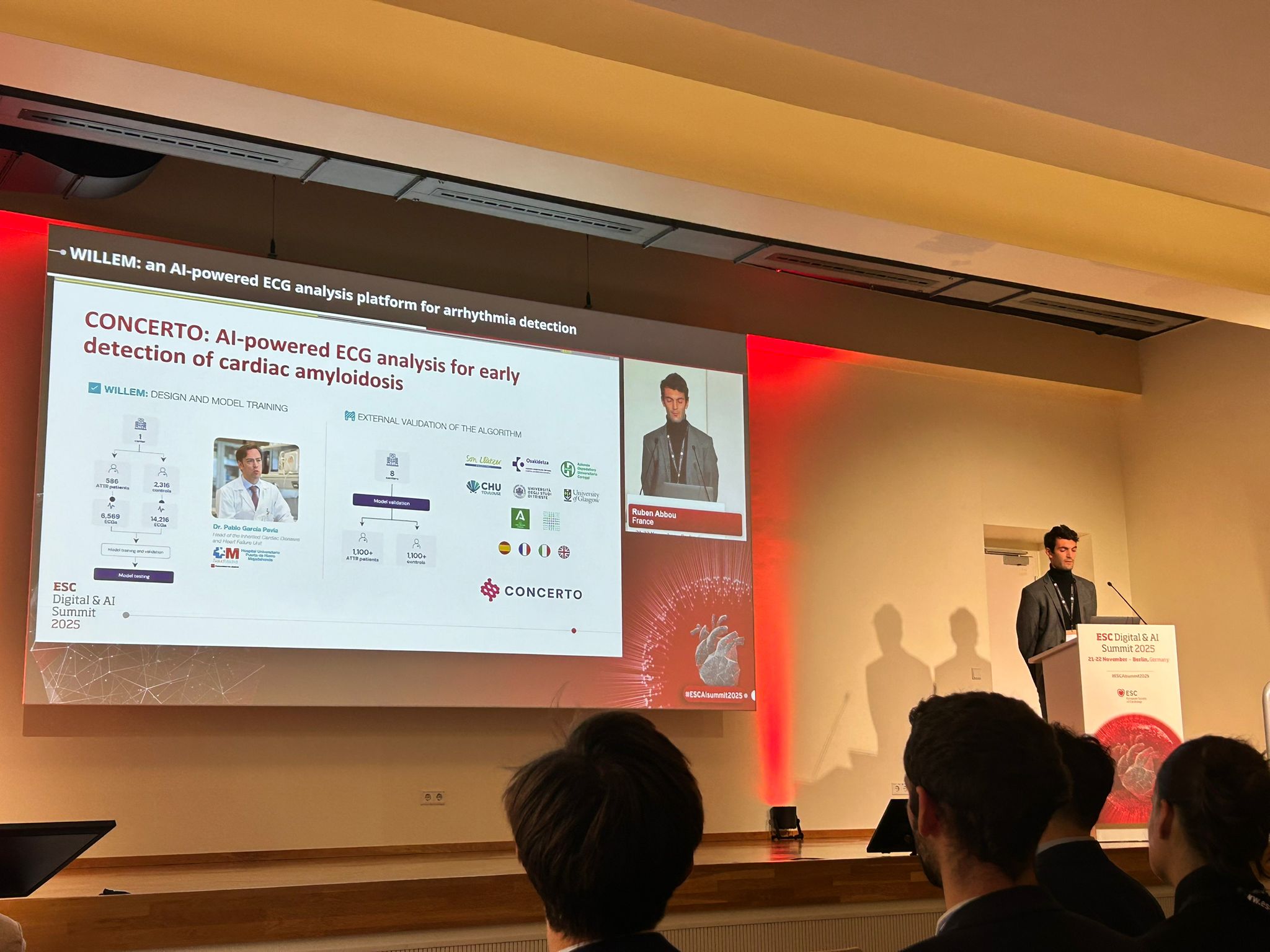
+ talk at ESC Digital & AI 2025, Berlin
ECGs curated
Anumana ~10M · Idoven ~600k
patients curated
multi-site clinical cohorts
pharma partnerships
AstraZeneca · Pfizer · Novartis
diseases on the ECG
amyloidosis · coronary disease · LV dysfunction · arrhythmias · myocarditis · long COVID
Sites & institutions
United States: Mayo Clinic (Rochester · Scottsdale · Jacksonville) · Northwestern (Chicago).
Europe: Puerta de Hierro (Madrid) · La Fe (Valencia) · Virgen de la Arrixaca (Murcia) · Juan Ramón Jiménez (Huelva) · Candelaria (Tenerife) · UMCG (Groningen).
Anumana · Boston · 2021–2024
ECG-AI at clinical scale.
- ECG-AI company, spun out of Mayo Clinic Platform
- 10M+ records, access to the Mayo Clinic ECGs
- Delivered for Pfizer and Novartis
Mayo Clinic co-authors: Paul Friedman, Zachi Attia, Francisco Lopez-Jimenez, pioneers of ECG-AI.
Amyloidosis project
Cardiac amyloidosis: FDA Breakthrough.
- Early detection of ATTR and AL amyloidosis (2.6k patients), from the ECG (deep learning) and from clinical data (signs, symptoms, labs), with Pfizer
- 3 gradient boosting models (AL, ATTR, combined), AUC 0.9, in shadow mode on a Mayo trial
- Target population, indication for use and validation protocol defined
- Contributed to the FDA Breakthrough Device Designation
LVEF project
LVEF: from model to reimbursement.
- Flagship LVEF model rebuilt from scratch: new cohorts (500K patients), new architectures, full retraining, AUC 0.94
- Health economics (HEOR): a Markov model extending the EAGLE trial, QALYs gained and savings for payers
Foundation models
Putting foundation models to work.
- Contrastive foundation model (ConVIRT) trained on 60% of the Mayo database, about 6M record-ECG pairs encoded as embeddings
- Embeddings plus logistic regression: the performance of a full training run, in seconds
- Faster iteration, with the effort concentrated on building cohorts
- Key risk: patient leakage between the foundation model and the downstream task
The rest
And the rest.
- Coronary risk (Novartis): CNN and Transformer on the ECG, beating the ASCVD score (10-year CV risk). The Lancet (eClinicalMedicine), 2023
- End-to-end data pipelines (Kedro, Spark): cohort traceability, absorbing constant data updates
- NLP pipeline (BERT): markers, symptoms and labs extracted from free-text notes, for cohort building and downstream classification
Idoven · remote from Paris · 2024–2026
CONCERTO: ECG-AI for ATTR amyloidosis.
The first European algorithm, run end to end with AstraZeneca, from the raw signal through to the CE marking dossier.
The full chain, end to end
Multi-site data
EU + US · AstraZeneca CRF
Reproducible pipeline
ingestion · cleaning · preparation
Signal
filtering · denoising · transforms
Model
TSCNN
Validation
subgroups · calibration
Regulatory
FDA · CE / SaMD
Health economics
QALY · payers
- 9 architectures compared (Bayesian optimisation), TSCNN selected, with explainability
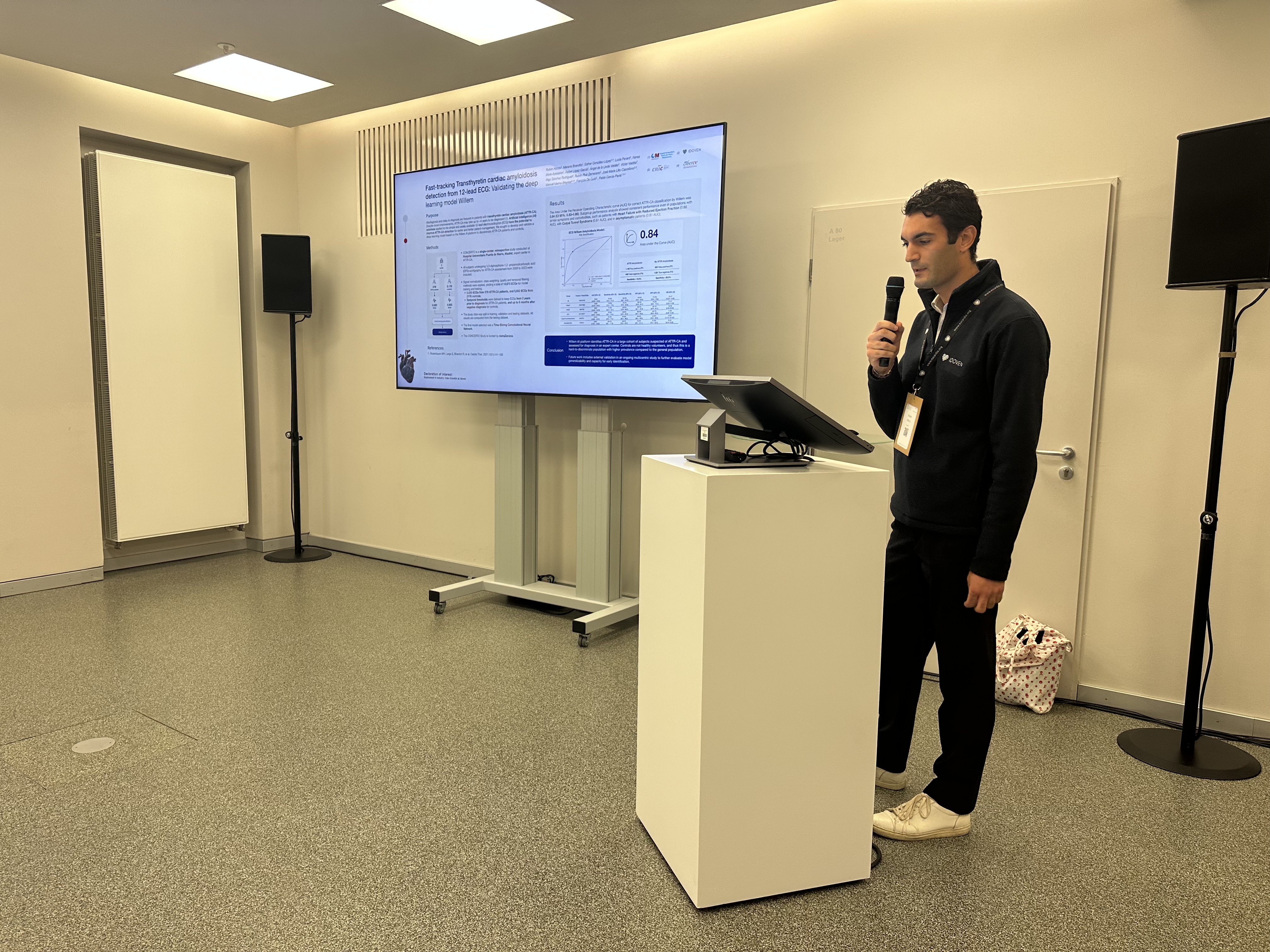
- ~20,000 ECGs, ~2,900 patients (~600 amyloidosis) at Puerta de Hierro (Madrid), Willem AI platform. González-López, Abbou et al., Heart Rhythm 2026; ESC Digital & AI 2025, Berlin
- AUC 0.88, sensitivity 80.7%, specificity 78.5%, detecting even asymptomatic forms (Se 68.4%)
- CE marking dossier (SaMD): calibration, thresholds, per-subgroup metrics, technical documentation
Alongside
The same pipeline, for athletic performance.
- The same signal processing as on the ECG, applied to my own physiology: Garmin data and blood work in a single warehouse
- 15 dimensions in one read (load, recovery, nutrition, biochemistry, sleep…), every calculation backed by a validated paper
- Risk modules (stress fracture, low energy availability / RED-S) to anticipate injuries. ~86,000 lines, ~3,400 tests
- In development. The goal: stay healthy and beat my own records
What drives me
Health data is under-used.
- French health data: vast, under-used, a goldmine for AI diagnosis
- Foundation models: learned on millions of ECGs, reusable, interpretable, quick to adapt
- End-to-end data pipelines: built once, so research moves without fighting the data
The engine
A multimodal foundation model for the ECG: the signal, the scanned paper trace and the clinician's text brought into one interpretable representation.
An application close to my heart
Helping choose a cancer treatment according to the cardiac risk read from the ECG, starting with prostate. No dedicated tool exists today.
Where I want to work
I speak all three languages.
What I bring
- ECG-AI already delivered (FDA Breakthrough, CE dossier)
- The whole chain, from signal to health economics
- At home in multi-site clinical data — real and imperfect
What I look for
- A large, real clinical ECG database, with the right to work on it
- Cardiologists in the room, not at the end of the pipeline
- The intent to ship a medical device, not only to publish
AI, regulation, the clinic — turning a database into decisions at the bedside.